
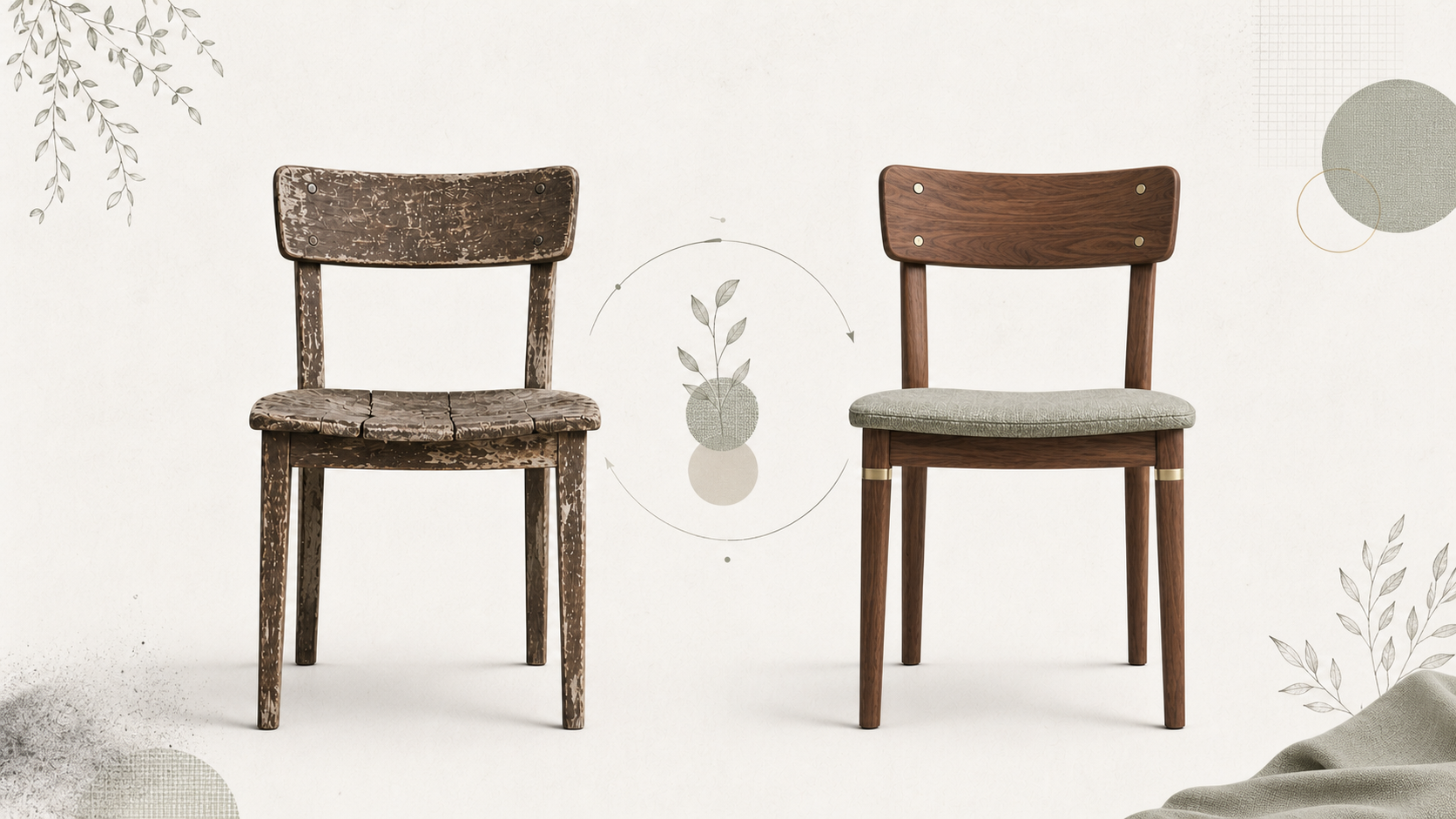
Most people assume that when a piece of furniture leaves their home for the last time, it gets recycled. It's a comforting assumption. It's also, in the vast majority of cases, wrong.
The Assumption Everyone Makes
Across Europe, 8 to 12 million tonnes of furniture are discarded every year, and the overwhelming majority of it, somewhere between 80 and 90 percent, ends up in landfill or incineration, with only about 10 percent recycled (a 2024 study by Technopolis Group, commissioned by the Dutch Ministry of Infrastructure and Water Management, drawing on European Federation of Furniture Manufacturers data). In the UK alone, 22 million individual pieces are thrown out annually.
Landfill or incineration. Not recycled. In most cases, not even broken — simply no longer wanted, in its current form, by the person who owned it.
Recycling Was Never Built for This
This isn't really a recycling problem, and that's the part that tends to surprise people. Recycling, as a system, was never built for furniture in the first place. A dining table is large, made of mixed materials, structurally awkward to break down, and impossible for a standard curbside program to handle. Even when furniture-adjacent material does get processed, what happens to it rarely resembles the tidy loop most of us picture.
A pair of jeans becomes furniture stuffing. That stuffing becomes insulation. At that point, it's gone.
The Ellen MacArthur Foundation has documented this clearly in textiles, and the logic transfers directly to furniture. Each step down the chain, the material loses value, and the object's original form and story disappear along with it. This is downcycling, and it's less a solution than a delay. Something we've decided to call "recycled" is often just waste taking the scenic route to the same landfill.
There's a version of sustainability that stops at this point, satisfied that at least the material didn't go straight to incineration. We don't think that's good enough, and increasingly, neither does European policy.
2026 Is a Turning Point
The EU's Circular Economy Act, moving toward adoption this year, aims to build a real single market for secondary raw materials and double the EU's circularity rate by 2030. From July, large companies in the textile and footwear sectors will be banned from destroying unsold stock outright, a direct response to years of usable goods being deliberately discarded rather than resold. And from September, new labels will start appearing at the point of sale across the EU, giving consumers clearer information about how durable and repairable a product actually is, before they buy it.
The direction of travel is unambiguous: policy is starting to reward things that last, and penalise things designed to be thrown away.
The Third Option
That leaves a genuine third option between "keep using it as-is" and "recycle it into something smaller and worse": transformation. Not a repaint that papers over the problem, and not a teardown that erases what the object used to be, but a redesign that takes the piece's actual history seriously and builds something new on top of it. The material stays whole. The value goes up, not down. And an object that was two days from a skip becomes something somebody chooses, on purpose, to keep.
This is the gap ArtCycle exists to close. We connect people who have furniture worth transforming with local artists who can see past its current condition, so the material never has to take the long way down through downcycling at all.
See What It Could Become
Got something at home that's fully functional but no longer wanted in its current form? Upload your item and see what a local artist proposes, or browse the shop for pieces that have already made the trip from storage to living room.
Get Started →Further reading: Ellen MacArthur Foundation, A New Textiles Economy · European Commission, Circular Economy Act · European Environment Agency, textile consumption data

Sign in to your ArtCycle account to leave a comment.
Sign in to comment ↗