
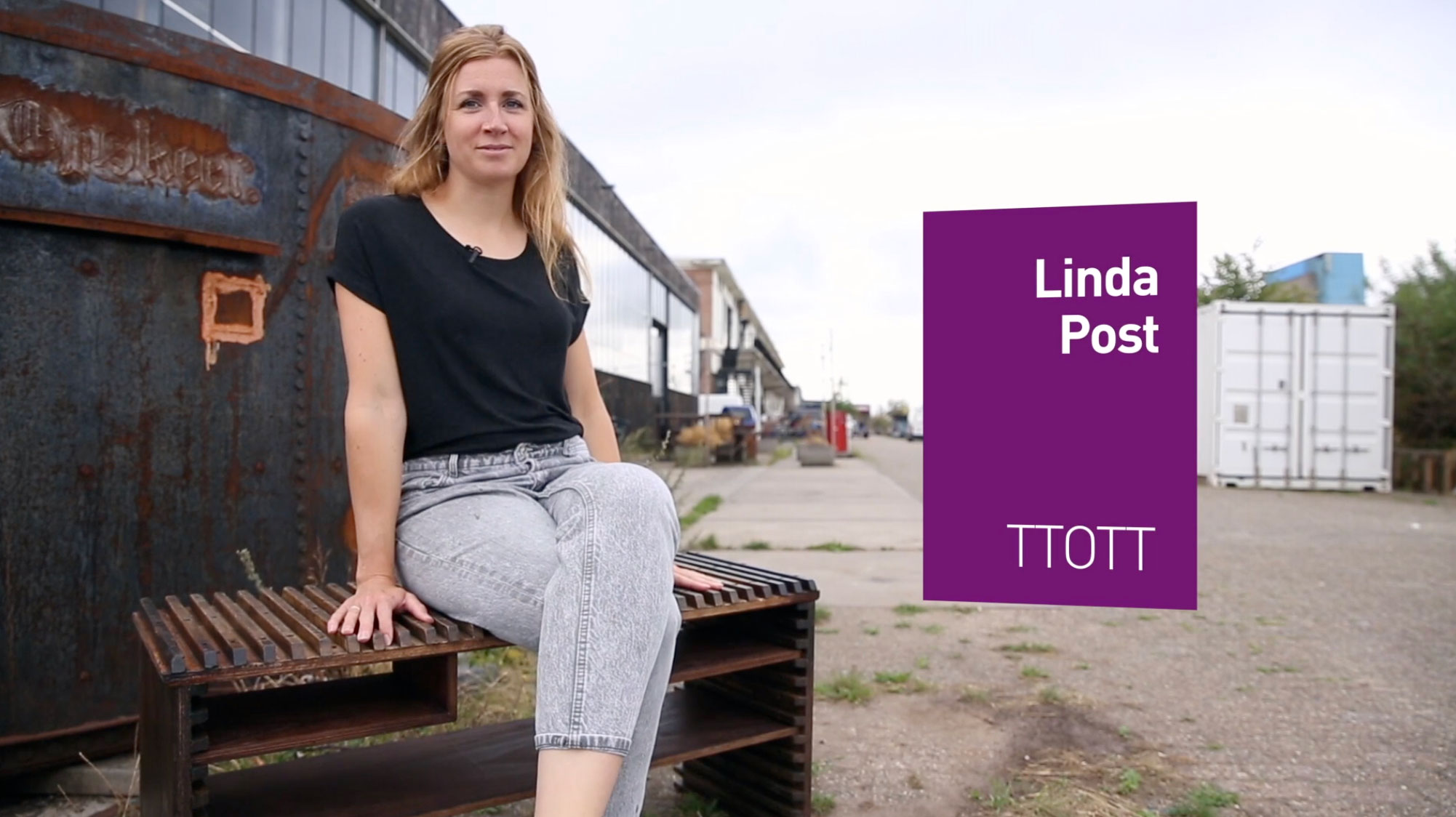
While the city tears itself apart and puts itself back together, one designer has been quietly collecting the pieces — and giving them back.
Rotterdam has a habit of destroying itself.
Not out of carelessness — out of ambition. The city was bombed flat in 1940 and has been rebuilding, rethinking, and reinventing itself ever since, with a restlessness that feels almost constitutional. Bridges get renovated. Tunnels get overhauled. Theaters get new seats. Stadiums get new everything. And when the workers leave and the scaffolding comes down, there are always leftovers: steel beams, wooden treads, bakelite wheels, orange carpet, theater armrests — the physical residue of a city that never quite stands still.
For most people, this is debris. For Linda Post, it is an archive.
Post is the founder of TTOTT — The Talk Of The Town — a Rotterdam design studio she started in January 2016 with her partner Leon Roozen. The premise is deceptively simple: when an iconic Rotterdam building or structure is renovated or demolished, TTOTT shows up, takes the material that would otherwise go to the scrapyard or the incinerator, and turns it into something you can put in your home.
A lamp made from steel sections of the Willemsbrug — the century-old suspension bridge that crosses the Nieuwe Maas in a single red arch — now sits on people's desks and bedside tables. Benches made from the original wooden escalator treads of the Maastunnel, the 1942 pedestrian tunnel that runs under the river, are used as furniture in living rooms across the city. Candle holders turned from bakelite wheels salvaged from that same tunnel. Footstools cut from 400 square meters of orange carpet that once covered the Rooftop Walk, a temporary pedestrian bridge that drew 204,000 visitors in the month it existed. Seats from the Luxor Theater, rescued when the historic venue was being refitted.
Each object is, in a precise sense, irreplaceable. When the material runs out, the product stops. Op is, as Post says, echt op — truly gone.
Post grew up with the instinct that most people lack the patience for: she kept things. Not hoarder-style, not sentimentally — purposefully. For as long as she can remember, she collected discarded materials with the conviction that she could do something with them. The comments were predictable. What on earth do you need that for? She held onto the materials anyway.
What changed was Rotterdam itself. Watching the city's most recognizable landmarks disappear piece by piece into renovation sites, she noticed something that troubled her: the finest material — the steel with history in it, the wood worn smooth by a million hands, the components that had been part of a shared civic experience — was almost always scrapped without ceremony. Melted down. Burned. Gone.
"The most beautiful material of the city's icons almost always ended up at the scrap dealer or in the incinerator," she has said. "I found that a shame. People have beautiful memories connected to all those different icons. I wanted to do something with that."

The mission, as she puts it with characteristic directness, was born.
The work is not always easy or clean. Sometimes the salvaged materials contain lead paint or asbestos — traces of the industrial past that require specialist pre-treatment before they can be handled safely. For processes too intensive or technical for a small studio, Post collaborates with craftsmen: a blacksmith here, a woodworker there. She assembles much of the work herself, in her workshop at Keilewerf, a former industrial harbor complex in the west of Rotterdam where artists, makers, and startups have quietly taken root among the loading docks and warehouses.
The products come together slowly, with a care that the original materials never received when they were simply infrastructure. A lamp is assembled from steel that once held a bridge over a river. A bench holds the weight of a person the same way an escalator tread once held the feet of thousands of commuters crossing beneath the Maas. The past is present in every piece — not as nostalgia, but as fact.
What makes TTOTT more than a clever upcycling story is the relationship it creates between object and owner. Post is not selling design pieces in the abstract. She is selling a piece of a specific place, at a specific moment in that place's history, to someone who almost certainly has a memory attached to it.
The Willemsbrug was the bridge you crossed on your way to work. The Maastunnel was where your grandmother took you by the hand as a child. The Rooftop Walk was the thing you kept meaning to visit — one day, before it disappeared.
It did disappear. But not entirely.
"How wonderful," Post has said, "that we can make people happy with their favorite piece of Rotterdam."
Rotterdam is, she notes cheerfully, always under construction — which means the supply of material with stories in it is, in theory, inexhaustible. She has had her eye on De Kuip, Feyenoord's legendary stadium, for years. Requests have started coming in from other cities. The Hague. Further. The concept, she acknowledges, works anywhere there are places people love and the inevitable machinery of renovation.
"If it's about giving back something that would otherwise be lost," she says, "then that can happen everywhere."
There is something quietly radical about this position. In a design culture that often prizes the new — the novel material, the breakthrough process, the product that didn't exist before — Post's work proposes a different kind of value. Not the value of innovation, but the value of continuity. Not what can be made, but what can be kept. Not a new story, but an old one — handed back to the people it belongs to, in a form they can hold.

The studio is not large. The operation is not industrial. The products, by definition, are finite. But the idea behind them — that a city's discarded materials are worth more than their weight in scrap metal, that memory is a design material as real as steel or wood — is the kind of idea that scales without scaling, because it changes how you look at every renovation site, every demolished building, every piece of infrastructure being quietly retired from a life of public service.
Once you know that an escalator tread can become a bench, you start to see the city differently. Less as a collection of structures, more as a collection of stories waiting to be redirected.
Linda Post has spent the better part of a decade redirecting them — one lamp, one bench, one candle holder at a time.
Image source: TTOTT Design
TTOTT Design is based in Rotterdam. More information at https://www.ttottdesign.nl/
This article was written by ArtCycle as an editorial feature based on publicly available information and research about Linda Post and TTOTT Design.
Sign in to your ArtCycle account to leave a comment.
Sign in to comment ↗