
LOCAL ARTISTS
Sander Wassink:
Designing a System That Makes Room for Difference
How a collaboration with Piet Hein Eek at Dutch Design Week 2026 challenges the way we think about furniture, waste, and standardization.
At Dutch Design Week 2026, among the polished objects and carefully staged concepts, a set of unusual chairs stood out by looking almost unfinished.
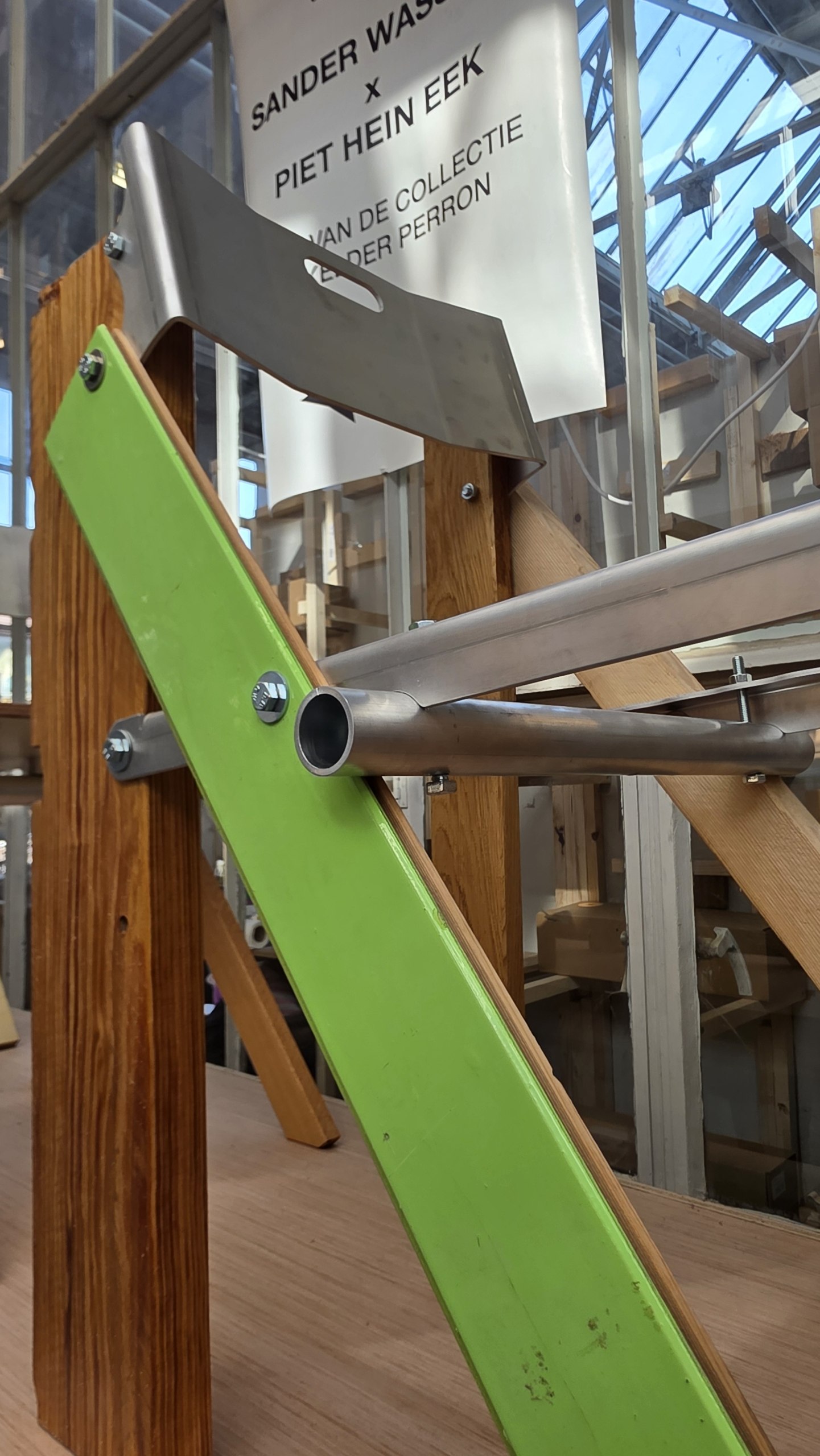
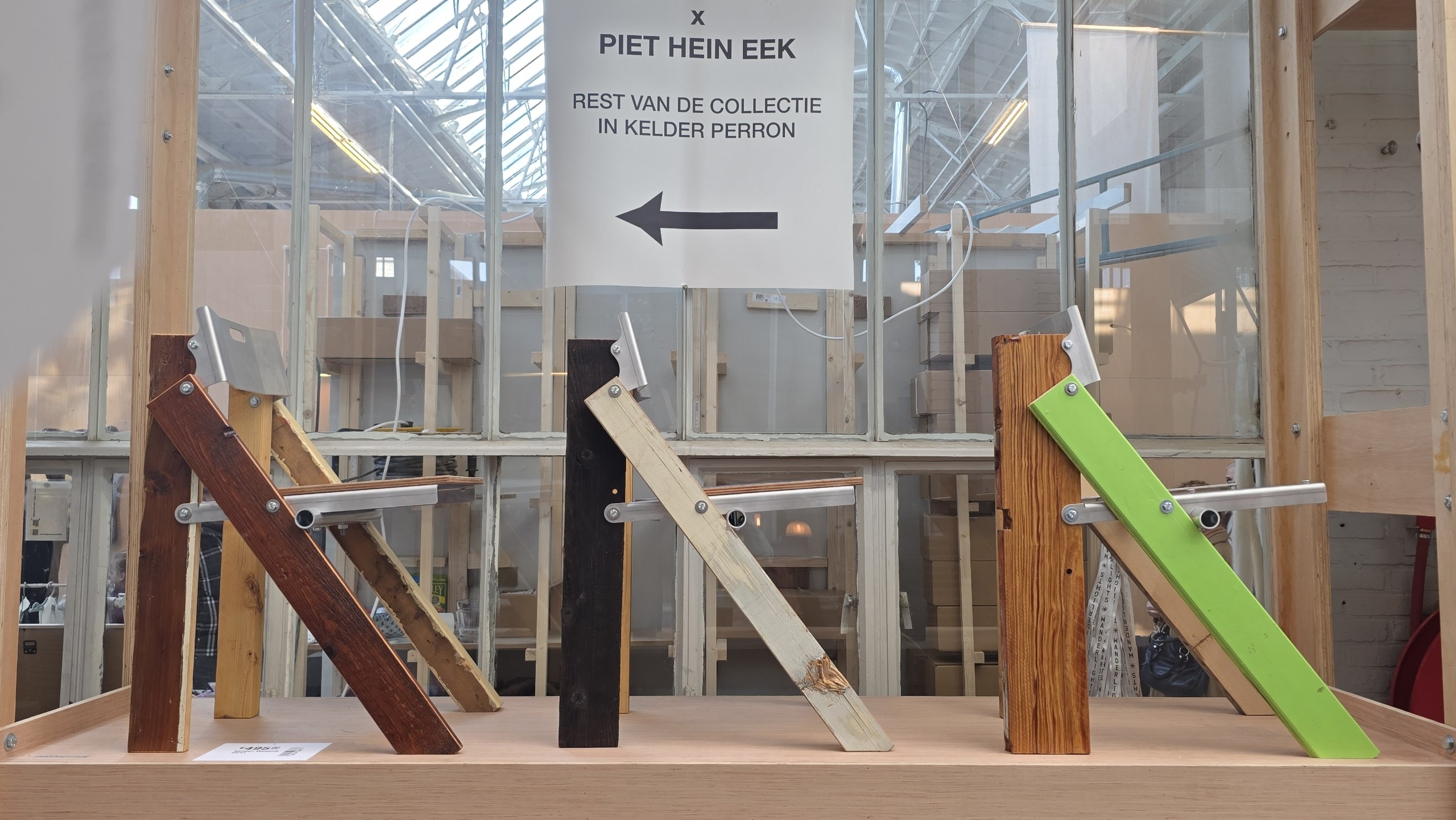
Wooden boards of different thicknesses. Exposed bolts. Aluminium joints. Surfaces that didn't match, some painted, some left raw. The construction was visible, deliberately so.
The chairs are part of V8.4, a collection made with Piet Hein Eek from leftover wood off his own workshop floor, built around a system designed by Dutch designer Sander Wassink.
At first glance, they could pass for furniture assembled from whatever was lying around. Look closer, and there's a system behind the irregularity, one carefully engineered to allow for it.
That is what makes the project worth stopping for.
These chairs aren't simply a clever use for scrap wood. They ask a sharper question: what if furniture were designed to accommodate the materials we already have, instead of requiring materials to fit a predetermined design?
A Small Set of Parts, Countless Possibilities
The principle is simple enough to state in a sentence.
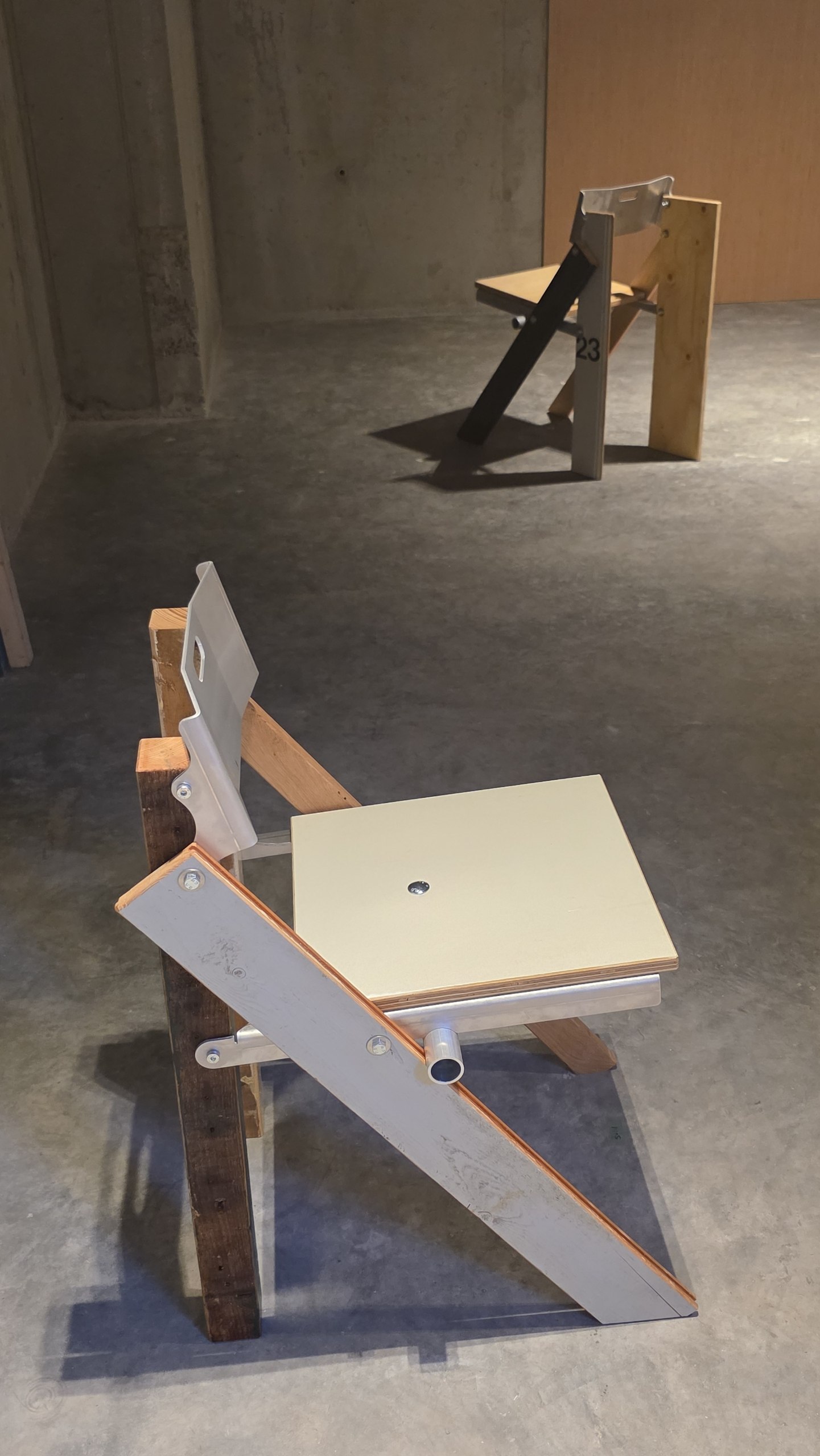
Every chair in the V-Series is built around the same small set of standardized aluminium components, custom-engineered and produced in the Netherlands by TailorSteel. They form a fixed skeleton. Everything attached to it is free to vary.
For the Piet Hein Eek collaboration, that meant building with whatever leftover wood his workshop had on hand.
Instead of cutting every board to the same dimensions, the system absorbs different widths and thicknesses as they come. The wood's existing condition, not a design spec, decides the shape.
A narrow offcut becomes a leg. A wider panel becomes a seat. A scratch or an old coat of paint doesn't need to disappear before the piece counts as finished.
The chairs share a structure. They don't share an appearance.
It's an unusual use of standardization. Most manufacturing uses standard parts to make identical products, efficiently, at scale. Here, the standard part is what makes the variation possible, not what eliminates it.
The aluminium does the one job that has to stay consistent. Everything else stays open.
A Different Kind of Collaboration
The partnership brings together two different ways of thinking about design.
Eek built a career on giving discarded and leftover material a second use, and on proving that visible construction and a material's history can be a selling point rather than a flaw.
Wassink works a layer up from that. Rather than designing one finished object, he designs the system that decides how objects get made, altered and remade.
The V-Series grew out of a three-month collaboration in Japan, working with roughly ten partners, from industrial manufacturers to small traditional workshops. It became the basis for a 2025 commission at the Dutch Pavilion for Expo Osaka: five variations of a single chair design, each shaped by a different maker and a different material. The system stayed constant. The results didn't.
The DDW26 collaboration with Eek puts that same logic to work with a different kind of material: not precision partners in Osaka, but a woodworker's scrap pile in Eindhoven.
One side supplies a workshop full of material. The other supplies a system that knows what to do with it.
Neither the material nor the system has to dictate the whole result.
What We Noticed at Dutch Design Week
Seeing the chairs in person shows something photographs of finished furniture usually hide: the decisions behind how they're put together.
Nothing is hidden under upholstery. Bolts sit in plain view. Metal meets wood at a visible joint. Some boards look rough or worn; others are painted in bright, flat colour.
One chair paired a vivid green panel with raw wood and silver metal. Another combined pale plywood with darker structural pieces.
They read as related. Not identical.
What stood out most was how little effort went into disguising the differences between materials. Nothing pretends the pieces always belonged together.
The differences are the point.
That's a real departure from how most mass-produced furniture signals quality, through consistency, flawless surfaces, nothing out of place. Here, quality shows up differently: in how smart the joints are, how adaptable the structure is, in what was made of the material at hand.
From Finished Product to Open System
The V-Series isn't built to end with one exhibition.
Wassink describes it as a framework meant to keep evolving through different makers, places and materials, closer to open-source design than a fixed product line. The aluminium skeleton stays standardized. What gets attached to it stays open to reinterpretation, wherever it lands next.
That distinction is worth sitting with.
A lot of upcycling work produces beautiful, one-off objects that are genuinely hard to repeat. Each new piece can mean solving the structural problem from scratch.
A modular system is a different bet. If the connection between parts is already solved, the work that's left is about the material itself, not reinventing the joint every time.
A maker can respond to what's in front of them instead of starting from zero.
That doesn't remove craftsmanship from the process. It moves where the craftsmanship goes.
And while a system like this doesn't automatically make furniture sustainable, it opens real, practical room for repair, adaptation, reuse, and whatever comes next.
The Value of Imperfection
There's another idea running underneath all of this: the link between how an object looks and how much it's worth.
Furniture tends to get judged by how new, complete or uniform it looks. A scratch lowers the resale price. A mismatched replacement part reads as a flaw. A board with odd dimensions gets rejected before anyone asks what it could become.
None of that is inevitable. It's shaped by what we've decided a finished product should look like.
The V8.4 chairs make the opposite case. The differences aren't problems waiting to be corrected. They're the starting condition the design works from.
That's not an argument for reusing everything, or treating every irregular object as automatically valuable, structural safety, durability, function, and the real cost of transformation still matter. It's an argument for loosening the criteria we judge materials by.
Something unsuitable for one design might be exactly right for another.
Sometimes the limit isn't the material. It's the system we're asking it to fit into.
What Circular Design Can Learn from V8.4
The circular economy usually gets discussed in terms of materials: how much waste gets diverted, how much gets recycled, how much new material gets avoided.
Those numbers matter. But V8.4 points at a different question.
Can we design products, and production systems, that are better at working with what already exists?
For creative reuse, that question sits at the centre of everything.
A discarded object rarely shows up in ideal condition. It comes with the wrong dimensions, an old finish, a history, a limitation nobody planned for.
Most product design handles that uncertainty by designing it out, specifying the material in advance and working backward. Wassink's approach does something closer to the opposite: it builds the uncertainty into the system from the start.
At ArtCycle, that's close to a question we return to constantly: how do you look at an existing piece of furniture and work out what it can actually become?
Not everything needs a full redesign. Some pieces need a repair. Others need a new function, a new setting, or an intervention that notices potential nobody else saw.
The hard part is always the same: understanding what an object can become before deciding what to do to it.
V8.4 doesn't solve that by designing one perfect outcome. It solves it by leaving room for several.
Designing for What Already Exists
The most interesting thing about these chairs wasn't how different they looked from each other.
It was how naturally that difference fit inside one system.
The wood didn't need to be made uniform. The joints didn't need to disappear. No two finished chairs needed to match.
Each one came out of a negotiation between the material, the maker and the structure holding it together.
In a design culture still mostly built around producing new objects to exact specifications, that's a genuinely useful way to think differently.
The future of circular furniture may not depend only on finding better uses for discarded material. It may depend just as much on building better systems for working with it.
Maybe better furniture doesn't always start with better materials. Sometimes it starts with a design that's better at working with the materials already in front of it.
Project Information
Featured designer: Sander Wassink
Collaboration: Piet Hein Eek × Sander Wassink
Project: V8.4 / V-Series
Exhibition: Dutch Design Week 2026, Eindhoven, the Netherlands
Photography: Hanaa Yazdi / ArtCycle, Dutch Design Week 2026
Sources and further reading
- Studio Sander Wassink — V-Series
- Piet Hein Eek — Dutch Design Week 2026 Designer Exhibition
- Studio Sander Wassink — Official Website
This article is an independent editorial feature by ArtCycle. It does not imply a commercial partnership with the featured designers.
Sign in to your ArtCycle account to leave a comment.
Sign in to comment ↗