
CIRCULAR ECONOMY
Everyone Wants a Repair Economy. Who Is Going to Do the Repairing
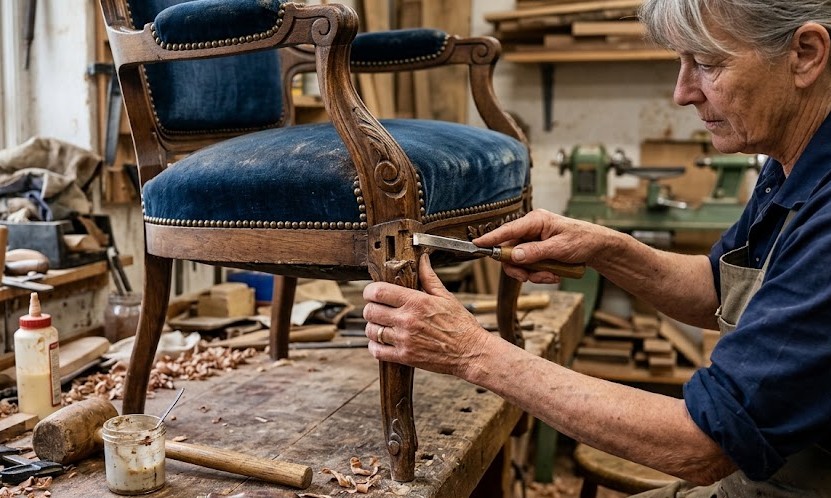
ReUse Alliance inventoried just 235 furniture repairers in the Netherlands,
While 2030 demand is projected at 6,000 to 9,000. What the shortage means for a platform built on local makers.
"Furniture repair is growing. But who is going to do the work?"
It's easy to miss why that matters. Furniture waste has a villain everyone already recognizes: flat-pack culture, fast furniture, a sofa that's cheaper to replace than reupholster. Less discussed is the other half of the equation. Even if every discarded chair in the Netherlands were worth saving tomorrow, saving it still requires someone with the actual hands to do it. Right now, that someone is in short supply.
The Furniture Isn't the Only Problem
Start with what's actually being thrown away. The Netherlands buys roughly 90 million kilograms of furniture every year and discards about 80 million kilograms, most of it incinerated rather than repaired or resold. That works out to something like 6 million individual pieces of furniture a year. Of those, ReUse Alliance's own research puts about two-thirds, roughly 4 million pieces, as technically repairable. Only 7 percent are genuinely beyond saving.
The gap between what could be repaired and what actually gets repaired isn't a materials problem. It's a behavior and infrastructure problem. Consumers say they're willing: 68 percent report openness to repairing furniture rather than replacing it. Only 17 percent actually do. Part of that is price, 63 percent believe new furniture is cheaper than fixing what they already own, and part of it is simply that the option often doesn't exist: 42 percent of Dutch furniture retailers offer no repair service at all, and only 16 percent sell anything secondhand or refurbished.
The Workforce Is
Here's a number that makes the shortage concrete. In 2023, ahead of launching a national directory of furniture repairers, ReUse Alliance inventoried and interviewed 235 of them across the Netherlands. Most work as freelancers or in businesses of two to five people. Large retailers, the report notes plainly, have largely stayed out of repair altogether.
Two hundred and thirty-five repairers, tracked down one by one to build a directory, for a country discarding roughly 6 million pieces of furniture a year.
Now put that number next to demand. ReUse Alliance's own projection: meeting furniture repair demand by 2030 will require somewhere between 6,000 and 9,000 skilled repair workers. Their stated ambition, the goal they're actually building toward, is to sustainably employ 3,000 of those by 2030. Even the optimistic scenario covers well under half the projected need.
The training pipeline isn't ready either. There is currently no formal vocational (MBO) qualification specifically for furniture repair in the Netherlands. Several proposed training programs were rejected by accreditation bodies for insufficient "market relevance", a strange verdict for a trade the same researchers project will need thousands of new workers within four years. Among vocational instructors in the broader "Bouwen Wonen Interieur" track, only 15 percent currently teach with reclaimed materials at all, even though 60 percent say they'd be willing to if they had the time, resources, or a curriculum to follow.
IKEA Netherlands is already moving in this direction. The retailer has said it wants to double its secondhand furniture offering and make repair accessible enough that furniture actually lasts, and its buy-back program sits inside the same ReUse Alliance coalition working on the workforce problem. The demand side of this isn't theoretical.
What's Actually Being Built
To its credit, the ReUse Alliance coalition, more than 30 partners including IKEA, Marktplaats, Repair Café, Kringloop Nederland, and the furniture trade association CBM, isn't just naming the gap. Six short training programs are already running in three regions. Zwolle ran a 12-week furniture repair course through CIBAP Next and Deltion college in September 2025, aimed specifically at status holders (newcomers with refugee status) entering the trade. Rotterdam launched a short MBO-level program for school leavers and career-changers. Utrecht built a course specifically around reviving used office furniture.
It's a start, not a solution. Six regional pilots training a few dozen people a year don't close a gap measured in thousands.
You Can't Build a Repair Economy Without Repairers
That's the sentence the entire policy conversation keeps skipping. The EU's right to repair rules, IKEA's buyback ambitions, every circular economy target the Netherlands has set for 2030, all of it assumes the labor exists to do the actual work. Right now, for furniture specifically, it mostly doesn't.
It's being built, slowly, by a coalition that had to go count its own workforce by hand because no one else had.
The Missing Infrastructure Isn't Only Physical
ArtCycle isn't training the 6,000 to 9,000 repair professionals the Netherlands may need. And not every artist or maker in our network is a furniture repair specialist.
But the shortage points to something important for platforms like ours: the people with practical skills cannot be an afterthought in the circular economy. Repairers, restorers, upholsterers, craftspeople, and artists working with existing objects are part of the infrastructure.
A repair economy needs workshops, tools, and training. But it also needs something less visible: a way to connect an object that needs work with a person who knows what to do with it. That connection is one of the problems ArtCycle is trying to solve.
Meet the Artists →Sources: Het Groene Brein / ReUse Alliance · "Werken aan de meubelsector van de toekomst" (Nov 2025) · ReUse Alliance Reparatiebanen


Sign in to your ArtCycle account to leave a comment.
Sign in to comment ↗