
CIRCULAR ECONOMY
The EU Just Made Repairability a Design Requirement. Is Your Furniture Ready?
Furniture Just Became an EU Policy Priority. Here's What "Repairable by Design" Actually Means.
On July 18, 2024, a regulation with an unglamorous name quietly entered into force in Brussels: the Ecodesign for Sustainable Products Regulation.
It's the EU's attempt to stop treating sustainability as a label you can buy and start treating it as a design requirement you can't skip. A year later, the Commission published its first list of which products get the new rules first.
Furniture is on it.
Europe Is Starting to Treat Repairability as a Design Problem
The Ecodesign for Sustainable Products Regulation, ESPR for short, works product category by product category. The Commission picks a priority group, commissions a technical study, and eventually issues binding rules on how that category has to be designed, manufactured, and documented. In July 2025, the Commission named its first five-year slate: steel and aluminium, textiles, furniture, tyres, and mattresses, alongside a number of energy-related products.
Furniture sitting on that list is the actual news here. It means the Commission intends to set ecodesign requirements for furniture within the current working plan's five-year window. What it doesn't mean, yet, is a fixed date. The Commission's own working plan commits to "considering" ecodesign and energy-labelling rules "over the next five years" for its named categories, without attaching a year to each one. Compliance trackers and consultancies have floated estimates anywhere from 2027 to 2028 for a furniture-specific delegated act, and those estimates disagree with each other, which is usually a sign that nobody outside the Commission actually knows yet.
One piece of the new framework is easier to describe: the Digital Product Passport, a kind of identity card that will travel with a product and store information on its materials, its repair history, and how it can be disassembled or recycled, accessible electronically to owners, repairers, and regulators alike. Furniture's own passport requirements haven't been finalized. But the direction is clear enough: a piece of furniture is meant to arrive with a record of what it's made of and how to take it apart, not just an assembly manual for putting it together.
A Screw and a Drop of Glue Are Not the Same Design Decision
Repairability doesn't get decided in a repair shop. It gets decided once, years earlier, at a drafting table.
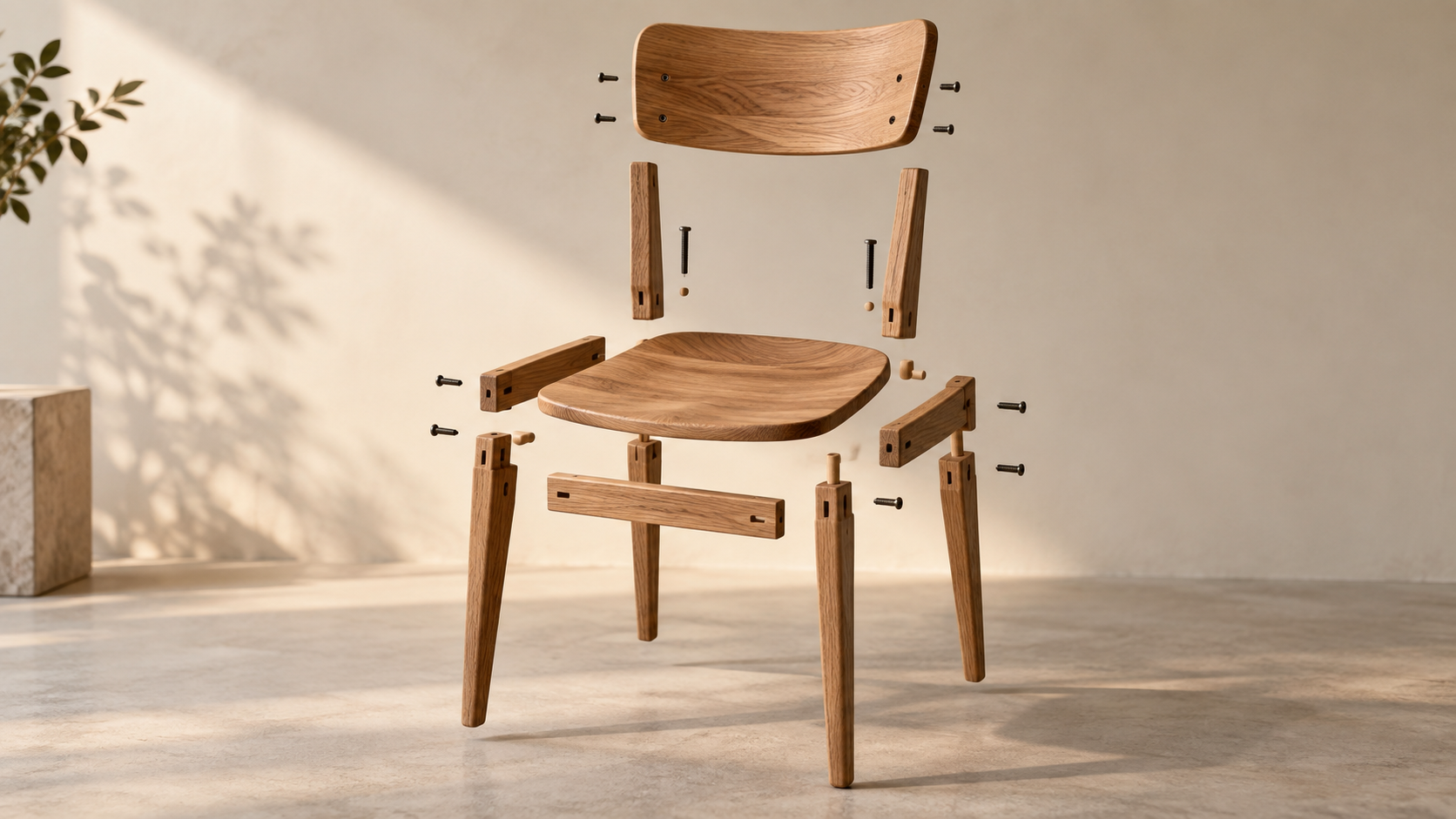
That choice compounds. A chair frame held with screws and dowels can be opened, a broken joint replaced, a worn seat re-covered, and closed again. A frame held with glue and staples can only be opened by destroying it. Both chairs might look identical in a showroom. Only one of them still exists in ten years.
The Commission's own preparatory work on furniture, run through the Joint Research Centre alongside its ongoing revision of EU Ecolabel and Green Public Procurement criteria for the category, already treats durability and repairability as evaluation criteria that sit next to recycled content and responsible material sourcing, not as an afterthought bolted onto a finished design. That's a meaningfully different starting point than asking, after the fact, whether a broken chair can be fixed.
We Have Been Designing for the First Sale
Most furniture on the market wasn't built with any of this in mind, because for decades nobody was asking it to be. The economics of mass furniture manufacturing reward one thing above all: getting a unit out the door as cheaply as possible. Glued joints are faster and cheaper to assemble than mechanical ones. Proprietary fittings are cheaper to source at scale than standard hardware a repairer could actually replace. None of that is a design failure in the narrow sense. It's a design working exactly as intended, for a single goal: the first sale.
What ESPR is proposing to do, category by category, is add a second goal that has to be satisfied at the same time: whatever gets sold also has to be capable of a second life. That's a genuinely different design brief, and furniture manufacturers haven't had to answer it yet.
The Best Repair May Happen Years Before Anything Breaks
It's tempting to picture "repairability" as something that shows up the day a chair leg cracks. Mostly it shows up much earlier than that, in decisions nobody sees: whether a joint is reversible, whether a part is standard or proprietary, whether anyone kept a record of what the frame is actually made of.
This is where the Digital Product Passport idea, whatever it ends up requiring for furniture specifically, is aimed at something real. A passport that traveled with a piece and told a future repairer, or a future maker reworking the piece into something else entirely, what it's made of and how it comes apart would remove a genuine barrier that has nothing to do with skill. Right now, an independent repairer or restorer often has to reverse-engineer a piece of furniture before they can even start deciding whether it's worth fixing.
But Repair Isn't the Only Way to Keep Something Alive
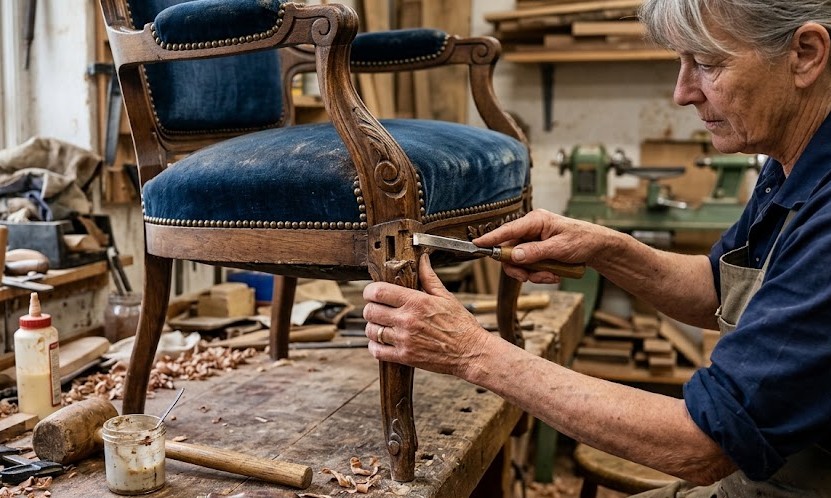
Repair assumes a piece is basically sound and just needs restoring to what it originally was. A lot of furniture doesn't fit that description, not because it's beyond saving, but because "restoring the original" was never the most interesting option. A water-damaged veneer, a dated finish, a frame that's structurally fine but visually tired, none of that is a repair job in the strict sense. It's a transformation job.
A repairable joint is useful to a repairer and just as useful to an artist who wants to open the same piece and give it a second identity rather than a restored original one.
That distinction matters more than it might seem, because the policy conversation happening in Brussels is largely a repair conversation: design for disassembly, design for durability, design for a technician to fix what broke. It's the right conversation to have. It's also not the whole one.
Design for the Second Life, Not Just the First
This is the part of the ESPR conversation that's easy to miss if you only read it as a compliance story. A piece of furniture designed to be taken apart cleanly, with materials that are documented and joints that are reversible, isn't just easier to repair. It's easier to reimagine. The same disassembly that lets a repairer swap a broken leg lets a maker strip a piece down to its frame and start over with it.
Sustainable material sourcing and recycled content, the other criteria showing up in the Commission's furniture work alongside repairability, point the same direction: furniture that was designed to eventually come apart, rather than furniture that was designed to be replaced whole.
Designing Again
Policy moves slowly, and furniture's specific rules under ESPR are still years, not months, away, with no confirmed date yet attached. None of that is a reason to wait. Design for disassembly, standard fittings, honest material records, these aren't ideas the Commission invented. They're what independent furniture makers, upholsterers, and restorers have been asking for all along, because it's what their work actually requires.
Furniture That Was Always Meant to Be Reopened
We're not waiting for a delegated act to find out whether a piece of furniture can be opened up and made into something new. Our network of local artists answers that question every week, one piece at a time, regardless of what the label on the frame says it was designed for.
A joint that comes apart cleanly is useful to whoever opens it next, a repairer following a future passport or an artist following their own eye. Either way, the piece gets to keep existing.
See What ArtCycle Artists Are Transforming →Sources: European Commission, Ecodesign for Sustainable Products Regulation · ESPR and Energy Labelling Working Plan 2025–2030 · Joint Research Centre, Furniture product group

Sign in to your ArtCycle account to leave a comment.
Sign in to comment ↗