
CIRCULAR ECONOMY
The Netherlands Is Building a Circular Future — What Does That Mean for the Objects in Our Homes?
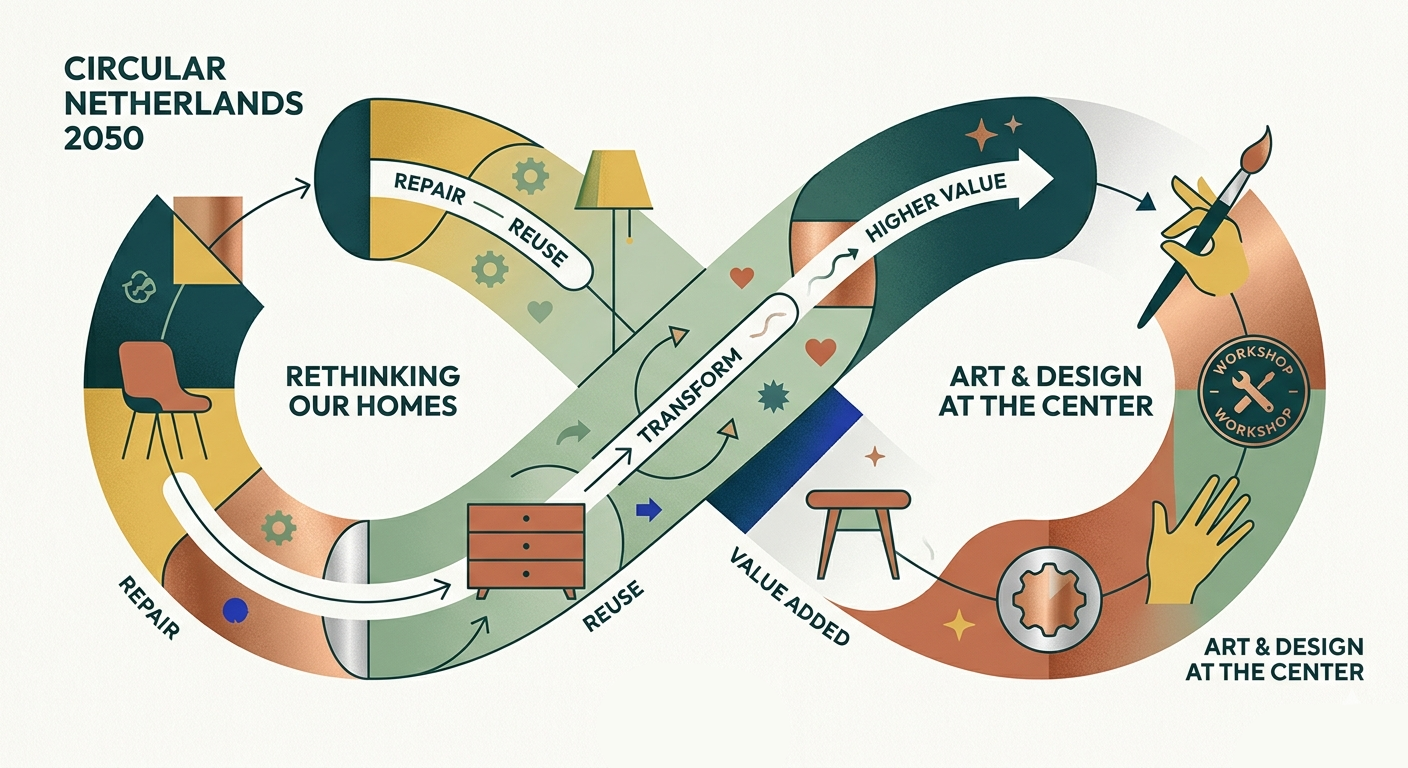
In 2023, the Dutch government reaffirmed its commitment to a fully circular economy by 2050 — one where no material is wasted, every resource is used at its highest value, and the concept of "throwing something away" becomes, effectively, obsolete.
It's an ambitious target. And it's already changing the way the Netherlands thinks about the things it owns.
What a circular economy actually means
The phrase gets used a lot. But stripped of jargon, a circular economy is straightforward: keep materials in use for as long as possible, at the highest possible value, for as long as possible.
That means repair before replacement. Reuse before recycling. Transformation before disposal.
The Netherlands has made serious structural progress — building reuse infrastructure through kringloop stores, investing in material research, and creating policy frameworks that push companies toward circular product design. But the transition doesn't just happen in factories or policy offices. It happens in homes. In the daily decisions people make about the objects they live with.government+1
The home as a circular economy frontier
247 million kilograms. That's how much furniture the Netherlands discards every year.
Think about what that number represents. Not industrial waste or corporate overproduction — though those exist too. This is household furniture. Things people bought, used, and eventually moved to a basement, a storage unit, or the street. A chest of drawers that no longer fits the bedroom. A dining chair with a cracked leg. A lamp that works perfectly but doesn't match the new colour scheme.
63% of what ends up in reuse stores is still fully functional. Most of it could be transformed, not just rehomed.
The circular economy's 2050 target will not be met by legislation alone. It will be met — or missed — one household decision at a time.
Why transformation is different from donation
Donating to a kringloop store is a good act. It keeps an item in use and out of landfill. But most donated furniture sells for €1–2, far below its material and design potential. The item gets a second life, but not a better one.
Transformation is different. When a skilled artist reimagines an object — reupholsters it, restructures it, paints it, builds it into something new — the item doesn't just continue its story. It enters a new chapter. Its value increases. Its lifespan extends dramatically. And someone, somewhere, chooses to keep it precisely because it's now worth keeping.
That's what the circular economy needs more of: not just efficient disposal systems, but objects that people actively want to hold onto.
What Rotterdam is doing about it
Rotterdam has become a city where circular economy principles meet real community life. From neighbourhood reuse workshops to gallery-studios that combine recycling and artistic practice, the city is building models for what urban circularity can actually look like — not as an industrial process, but as a cultural practice.uitagendarotterdam+1
ArtCycle is part of that ecosystem. We're based in Rotterdam. Our artists are from Rotterdam. The items we transform come from Rotterdam homes, and in many cases, they return to Rotterdam living rooms. The circularity isn't abstract. It's local, visible, and human.
The national policy target gives us the direction. The artists give us the means. And the objects in your home are where the work actually begins.
What's sitting in your basement that deserves a second story? [Submit your item →]
Sign in to your ArtCycle account to leave a comment.
Sign in to comment ↗