
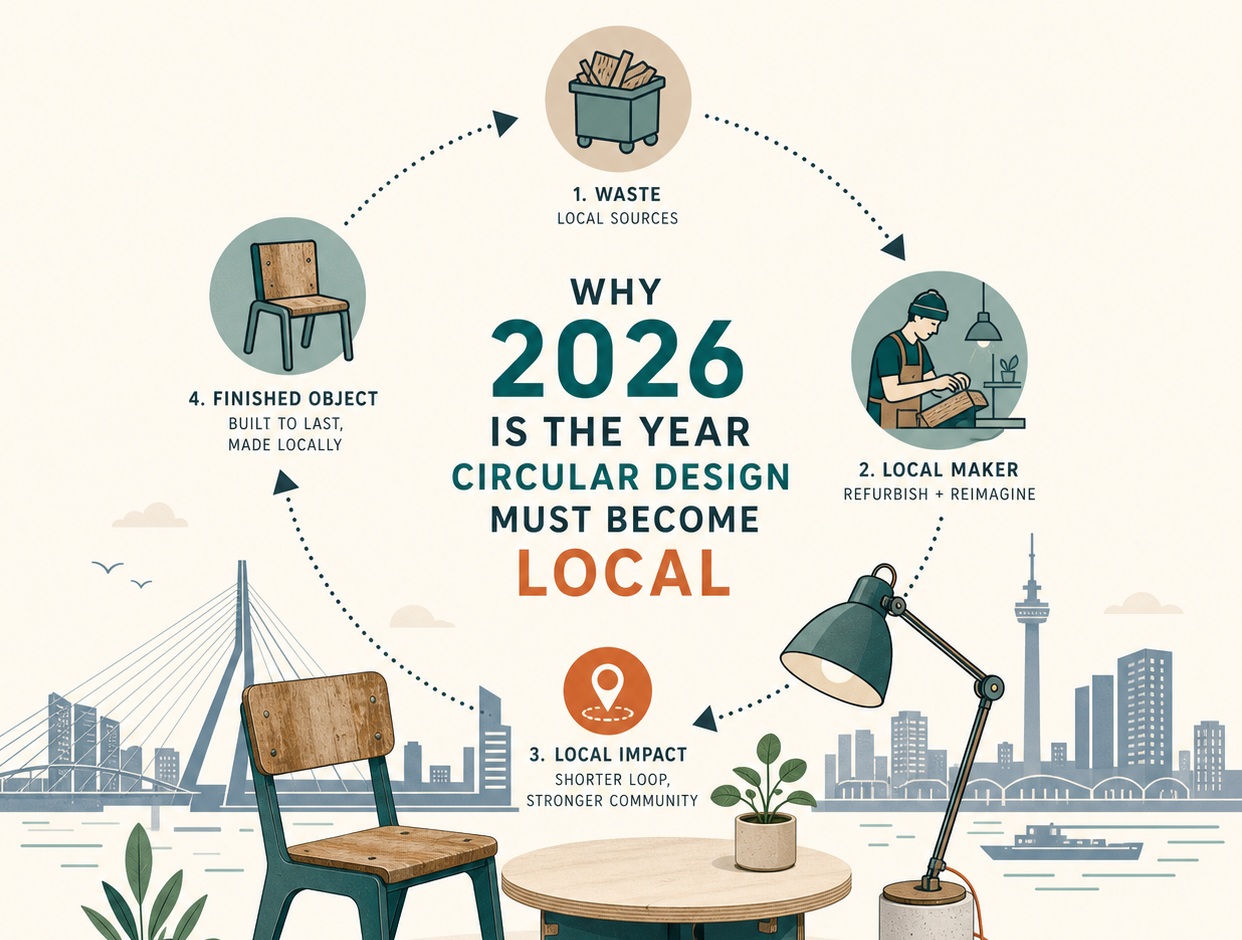
The Netherlands entered 2026 with a clear message: circularity must deliver results, not just promises. National policy still targets a fully circular economy by 2050, but this year, the focus has shifted to practical implementation — collaborative business models, local innovation, and turning waste into real economic value.
For design, that means one thing: circularity cannot stay abstract. It must become hyper-local.
The new pressure on circular design
Dutch companies are feeling the gap between ambition and action. The resource transition is accelerating, but many report that regulation and support still lag behind the rhetoric. Meanwhile, the Port of Rotterdam is actively revaluing waste streams as raw materials, proving that material transformation is no longer a side project — it's core infrastructure.publications.portofrotterdam+1
Sustainable interior design trends confirm the shift: upcycling, modular furniture, and reclaimed materials are surging because they deliver immediate impact without new production. But here's the challenge: most of these trends assume industrial-scale waste streams. What about the objects already in our homes?
Local makers as circular infrastructure
In 2026, the most effective circular design happens when skilled hands meet familiar objects. Not in factories, but in cities. A Rotterdam artist reupholstering a local sofa. An Eindhoven designer turning a discarded lamp into a sculptural light. These aren't one-off projects. They're the scalable model for what comes next.
Rotterdam's ongoing circular experiments — from port-level material recovery to community reuse initiatives — show why locality matters. When the person transforming your item lives in your city, understands your climate, and shares your aesthetic, the result isn't just sustainable. It's desirable.
ArtCycle's role in the local shift
We've always believed that circular design works best when it's personal. Upload an item from your Rotterdam home. Get proposals from local artists who know the light, the humidity, the style of the place. The transformation isn't generic. It's yours.
In 2026, with Dutch businesses pushing for collaborative circular models, platforms like ours become essential. We connect item owners with artists who would otherwise spend half their time hunting for materials and clients. The result: higher-value objects, steady artist income, and less waste leaving the city.
What local circularity looks like
This year, expect to see more Dutch design that prioritizes "nearby" over "efficient." Materials sourced within 50 kilometers. Makers who can visit your home to assess an item. Business models built on repeat local relationships, not one-way transactions.
That's the future ArtCycle is already delivering in Rotterdam. One object, one artist, one neighbourhood at a time.
Got an item waiting for its local revival? [Upload now →]
Sign in to your ArtCycle account to leave a comment.
Sign in to comment ↗